
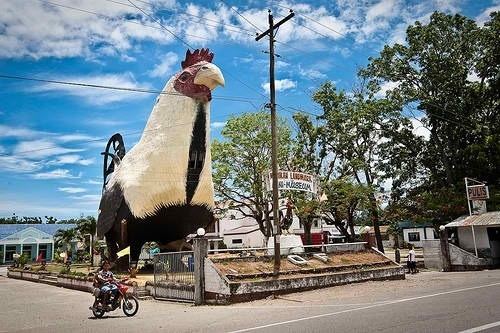
Hello I’m Jerson Gerodias and welcome to my blog this is my first time to do this. I will show you the beautiful places in zamboanga del Norte. The beautiful beach of Zamboanga Del Norte is Sta.Cruz Beach and also Dapitan this is a great place for you to rest and enjoy and lastly Manukan this is the place where you will see the biggest chicken so enjoy in reading and i hope you like it.

This is Zamboanga Del Norte the province’s land area is devoted to agriculture. Corn, coconut, and rice are major crops. The province being rich in marine and mineral sources, its fish production has accelerated through the development of fishponds. Commercial fishing has likewise steadily increased through the years, with the yellow fin tuna as the primary species.
Zamboanga del Norte is a province in the Philippines located in the Zamboanga Peninsula region of Mindanao. Dipolog City is its capital and is surrounded by Zamboanga del Sur and Zamboanga Sibugay to the south and Misamis Occidental to the east. The Sulu Sea is located northwest of Zamboanga del Norte

DAPITAN
the second place is Dapitan City is a 2nd class municipality in the province of Zamboanga del Norte, Philippines. According to the 2000 census, it has a population of 68,178 people in 13,560 households. The area is historically important because the Spaniards exiled the national hero Jose Rizal.

Sta.Cruz Beach
and the third place is Great Santa Cruz Island. The Great Santa Cruz is a small inhabited island in Zamboanga City in the southern region of the Philippines that is famous for its pink coralline sand. The island, located 4 kilometers (2.49 mi) south of downtown at the Santa Cruz Bank in the Basilan Strait, boasts the only pink sand beach in the Philippines. The color of the sand comes from the pulverized red organ pipe coral from eons of surf erosion mixed with the white sand. The island started to become popular since the 1970s and early 1980s when it was frequented by German, Japanese and Italian tourists. Recently, there’s an upsurge of tourists that has been recorded due to its rising popularity as one of a handful of Pink Sand Beaches in the World and is the only one in Asia. In 2017, it was recognized by National Geographic as one of the 21 Best Beaches in the World.
MANUKAN
the fourth place is Manukan. Manukan is a 3rd class municipality in the province of Zamboanga del Norte, Philippines. According to the 2000 census, it has a population of 31,855 people in 6,010 households. The seven barangays of Manukan town will be separated into a separate town of Ponot under the law of the National Legislative Assembly. 15. The ZAMBOANGA Peninsula was known as Sibugay or Sibuguey during the coming of the Spanish conquistadors. And later on was changed into Zamboanga from the capital town of the province which derived it’s name from the Malay word Sambangan meaning a place where wild flowers grow. The Spanish colonialization of Mindanao was done by sending missionaries and one of the sites was Sambangan. As the years went by, the mispronunciation of Bisaya (North Borneo dialect) and Spanish words turned into what is now Zamboanga. On June 23, 1635 the town was officially called Zamboanga. The boundary of the town of Zamboanga comprised half of the peninsula then. The entire peninsula was later called Zamboanga Peninsula although the easternmost part of the peninsula belongs to the Province of Misamis. The ZAMBOANGA Peninsula was known as Sibugay or Sibuguey during the coming of the Spanish conquistadors. And later on was changed into Zamboanga from the capital town of the province which derived it’s name from the Malay word Sambangan meaning a place where wild flowers grow. The Spanish colonialization of Mindanao was done by sending missionaries and one of the sites was Sambangan. As the years went by, the mispronunciation of Bisaya (North Borneo dialect) and Spanish words turned into what is now Zamboanga. On June 23, 1635 the town was officially called Zamboanga. The boundary of the town of Zamboanga comprised half of the peninsula then. The entire peninsula was later called Zamboanga Peninsula although the easternmost part of the peninsula belongs to the Province of Misamis. Before the Philippines was ceded to the United States of America (Treaty of Paris), the peninsula was partly to the south where ZAMBOANGA city proper is the Provincia Mora and towards the North where Dipolog City is a part of the Provincia Misamis. Dapitan district which includes Dipolog was part of Provincial Misamis. Each province has a governor and the whole Department of Mindanao and Sulu have also a governor. From 1903 to 1913 Zamboanga City was the capital of the Provincia Mora which comprise five districts, namely; Cotabato, Davao, Lanao, Zamboanga and Sulu.

 Site Title